
OPERATIONS / FOXBYTE SYSTEMS
Give everyday technology a clear support owner.
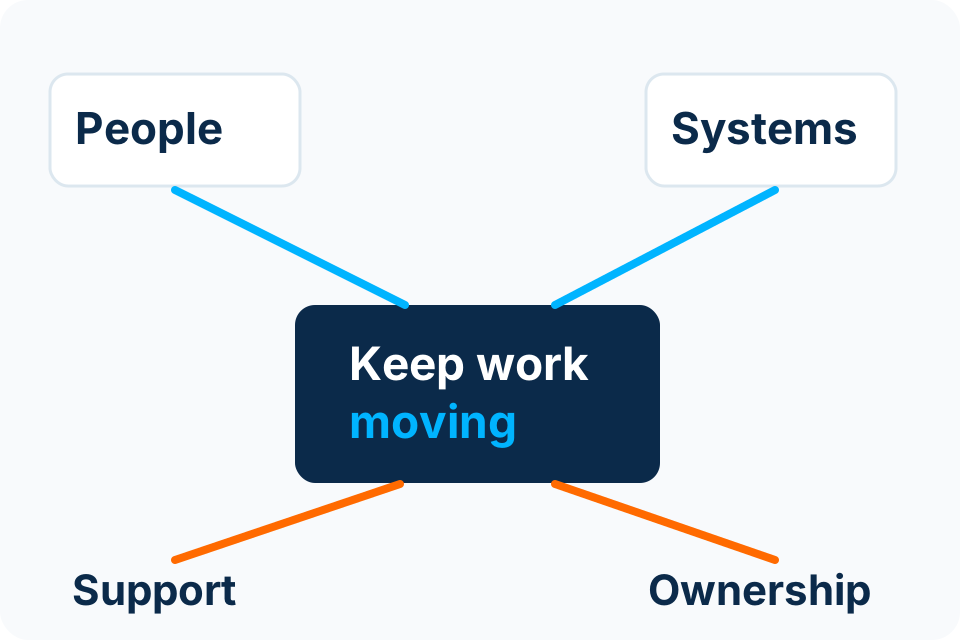
Support works better when people know where to ask for help and who owns the environment. Define the users, systems, service channels and limits before relying on a recurring agreement.
Illustrative process — agree the actual scope before implementation.
- UsersA known way to request help.
- SystemsA defined support boundary.
- OperationsA record of action and outcome.
Map the operating environment.
People and devices
Identify the users, locations and devices in scope, including remote working arrangements and shared equipment.
Applications and connectivity
Record the business applications, productivity services and connectivity dependencies that the team relies on.
Suppliers and responsibilities
Clarify where Foxbyte support, your internal team and third-party vendors each act. A supplier-managed application may require its own escalation path.
Put the service boundary in writing.
| Agreement area | What should be clear |
|---|---|
| Scope | Included users, sites, equipment, applications and separately quoted work. |
| Hours and channels | When human support is available and where requests should be recorded. |
| Priority and escalation | How impact and urgency affect handling, with any agreed response targets. |
| Access and changes | Who can authorise support access, purchases and disruptive changes. |
| Security and recovery | Which responsibilities are included, coordinated or separately scoped. |
| Licences and suppliers | Who procures, renews and escalates each dependency. |
| Reporting and exit | What records are provided and how access and knowledge transfer at handover. |
Published human contact hours are Monday–Friday 08:00–17:30 and Saturday 09:00–13:00, Africa/Nairobi. Sunday and public holidays are closed unless separately contracted. A specific managed-service agreement may define its own approved arrangements; this page does not advertise 24/7 human support.
Make support requests useful from the start.
Illustrative process — agree the actual scope before implementation.
- ReportDescribe the affected service and business impact.
- AssessConfirm the scope, priority and next owner.
- WorkUse authorised access and record relevant changes.
- ConfirmCheck the result with the affected user or service owner.
- ImproveUse recurring issues to inform the next review.
An acknowledgement is not proof that a fault has been resolved. A useful request record follows the issue, the action and the outcome. Avoid scattering the same incident across several unrelated channels.
See Foxbyte Support routesOnboarding should leave fewer unknowns.
- A usable inventory and ownership record for the agreed scope.
- Approved support access with accountable administration.
- Known risks, unsupported systems and existing contractual dependencies.
- A clear way for users to request help.
- Agreed recovery responsibilities and escalation contacts.
- A review plan for recurring issues and future needs.
A recurring service should help the business make better decisions about ageing devices, repeated faults and unsupported software. Replacement, new projects and specialist security work should be scoped explicitly rather than assumed to be unlimited support.
Choose the right related service.
Review cybersecurity responsibilitiesNeed additional computers, IT hardware or software? Foxbyte also handles sales, installation and configuration. Agree the equipment, licences and rollout work in the quotation; purchases and project setup are separate from recurring support unless expressly included.
Buy hardware, software and configuration services Discuss a separate recovery assessment Return to the Business IT decision hubManaged IT questions.
Is managed IT the same as break-fix repairs?
No. Break-fix work addresses an assessed problem; a recurring service defines ongoing support responsibilities around an agreed environment. The agreement should make the distinction clear.
Does every request include free onsite work?
Do not assume so. Onsite arrangements, locations, travel, project work and exclusions need to be stated in the proposal.
What does managed IT cost?
The environment and operating scope determine the quote. Provide approximate user/device counts, locations, applications, current pain points and the responsibilities you want covered.
Can we keep our existing internal IT team?
The support boundary can be discussed around an internal team and existing vendors. The important point is to avoid ambiguous or duplicated responsibility.
Define the support your team needs.
Start with the users, systems and recurring problems. We will help identify the right scope for the conversation.
Foxbyte Insights
Prepare for the decision.
Business IT
In-house, outsourced or shared IT support: choose by responsibility
Choose an IT operating model by the responsibilities the business needs covered. In-house, outsourced and shared arrangements can all work when decision authority and handoffs are explicit.
Foxbyte InsightsPublished Updated
Read the guide: In-house, outsourced or shared IT support: choose by responsibilityBusiness IT
IT onboarding for a new employee: a practical handover checklist
IT onboarding is complete when the new employee can perform the agreed work with appropriate access and knows how to get help. An account-created notification is only part of that outcome.
Foxbyte InsightsPublished Updated
Read the guide: IT onboarding for a new employee: a practical handover checklistBusiness IT
Write an IT support request that someone can act on
A useful IT request tells the support team what happened, who is affected and what the business needs restored. Clear evidence saves the first conversation from becoming a guessing exercise.
Foxbyte InsightsPublished Updated
Read the guide: Write an IT support request that someone can act on