
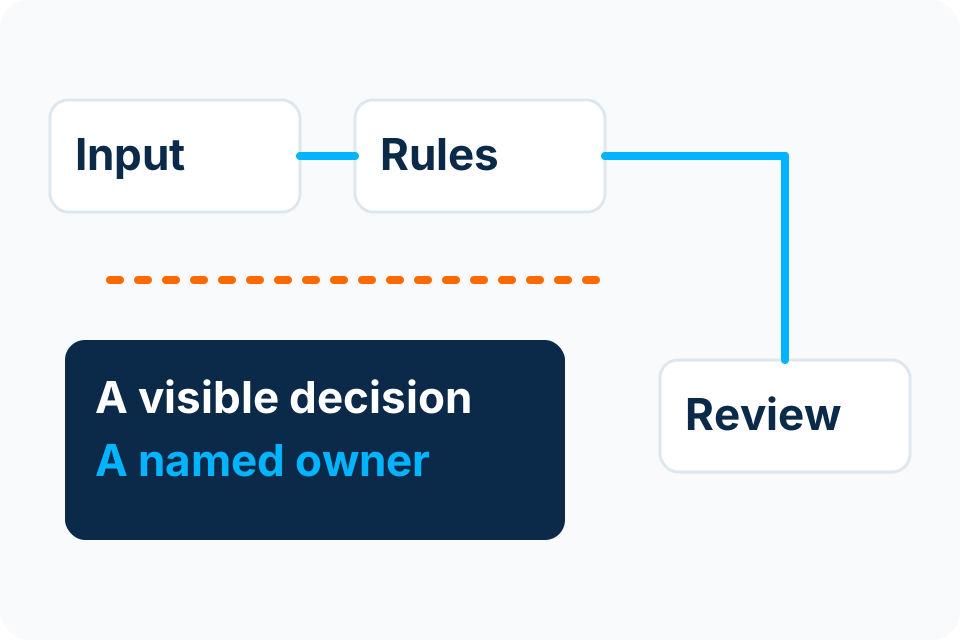
Choose a manageable outcome, not an impressive demonstration
A first automation should make one piece of work more dependable. “Capture a complete request, route it to the correct approver and show its status” is a testable outcome. “Automate our operations” is not. For a Kenyan business comparing proposals, this distinction makes the scope, responsibility and acceptance criteria easier to agree.
Start by naming the person who owns the business result. That person should explain the normal route, decide how exceptions are handled and accept the finished workflow. A developer can build a connection; they cannot invent an absent purchasing policy or decide who has authority to release money.
Our practical selection method below is a discussion aid, not a proprietary maturity score or a prediction of savings. It is designed to produce an evidence-backed starting point for workflow automation.
Assess these eight questions before selecting a pilot
Is the work repetitive enough to measure?
List the triggers and count representative occurrences over an agreed period. Distinguish active handling time from time spent waiting for a decision. An approval delay caused by unclear responsibility will not necessarily improve when the request moves into a different tool.
Are the steps stable and agreed?
Ask two people to describe the same process. Where their descriptions disagree, settle the process first. Frequently changing rules are not an absolute barrier, but every change needs an owner, a version and a test. A stable smaller workflow is usually a clearer first commitment than an unsettled enterprise-wide redesign.
Are the inputs usable?
Separate structured records, such as a validated form, from emails, scans and inconsistent spreadsheets. Look at missing fields, duplicate references and unreadable attachments. Record where information comes from and who may access it. Do not assume a readable PDF is ready for reliable extraction.
What happens outside the happy path?
Identify an absent approver, unavailable system, duplicate submission and incomplete request. Decide whether each item waits, retries safely, returns for correction or reaches a person. A process with a visible exception queue is more useful than one that silently loses unusual cases.
Which decisions must remain human?
Keep business authority explicit. An automation can assemble an invoice-review pack or highlight a mismatch; it does not thereby gain approval to pay a supplier. High-consequence decisions need an agreed approval and escalation model even when much of the preparation is automated.
Can the systems be connected safely?
Check supported interfaces, account permissions, licensing and available test environments. A screen that a user can click is not proof that a reliable integration is available. If a connection depends on a fragile desktop sequence, include monitoring, failure recovery and maintenance in the scope.
Is failure reversible?
Read-only reporting or request routing can be an easier starting boundary than actions that delete records or release funds. Define duplicate protection and reconciliation before allowing the workflow to write to an authoritative system. A retry must not create a second supplier record, booking or notification inadvertently.
Can the team own the result afterward?
Confirm who handles failed runs, permission changes, staff departures and process amendments. Include a handover and operating guide. A successful demonstration without a named support arrangement can become a recurring manual problem of its own.
Compare three plausible starting points
The following are illustrative scenarios, not Foxbyte client results.
Equipment or service request routing
Why it may be suitable: Defined fields and a clear status trail
Condition to resolve first: Agree the approver and the missing-information path
Recurring operational report assembly
Why it may be suitable: Repeatable inputs and a reviewable output
Condition to resolve first: Confirm access, source quality and reconciliation checks
Supplier invoice review preparation
Why it may be suitable: Repeated capture and checking work
Condition to resolve first: Separate extraction, validation and financial approval
A first pilot could deliberately stop at “ready for human review”. That is a useful operating boundary, not a failed attempt at full automation. The labelled invoice-review demonstration shows this distinction without implying a customer deployment or measured result.
Build a one-page baseline
Record the process owner, trigger, approximate case volume, systems, required fields, normal steps, common exceptions and approval points. Add a few consented or synthetic sample cases. Use a worksheet with columns for current handling, desired handling, responsibility and evidence of success.
Microsoft describes process mining as examining event data from systems. Those are possible discovery tools, not prerequisites for every small project. Use only proportionate collection with appropriate authorization; a short process workshop may be sufficient to scope a narrow pilot. Microsoft: process and task mining overview.
Do not submit staff passwords, customer records or unrestricted exports in a consultation form. Describe the information types and arrange a controlled review if samples are needed.
Define what the pilot must demonstrate
A useful acceptance test includes a valid request, missing field, duplicate request, rejected approval, unavailable approver and interrupted integration. Each case should leave a traceable outcome and an obvious next action. Decide what users can correct themselves and what requires an administrator.
Measure the agreed before-and-after quantities over a representative period. Record exceptions and additional review effort, not just the fastest successful run. A reduction in handling time is not automatically a cash saving or a guarantee of return on investment.
At the end, make an explicit decision: deploy within the tested boundary, revise the scope, or stop. Expanding to more teams or systems is a new scope decision, not something to hide inside a successful pilot.
When not to automate yet
Pause when the process owner is unknown, the rules are disputed, access is unauthorized, or a material decision cannot be reviewed. Fixing a form, responsibility map or inconsistent source record may deliver more immediate value than adding AI. Keep a backlog of deferred ideas with the reason and evidence required to revisit them.
Turn the shortlist into a scoped conversation
Bring your top two or three workflows, not a catalogue of software features. Explain the problem, current route, systems and one difficult exception. Foxbyte can scope an assessment, bounded pilot, implementation or ongoing management against those requirements. See AI Business Automation and when rules-based automation is enough.
Request an automation consultation