
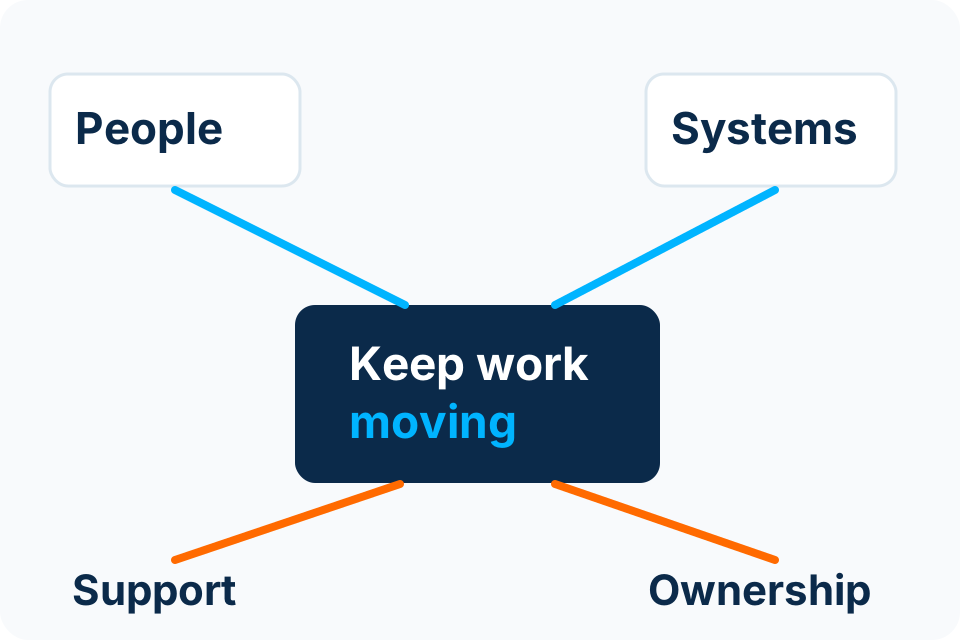
Choose an IT operating model by the responsibilities the business needs covered. In-house, outsourced and shared arrangements can all work when decision authority and handoffs are explicit.
List the work before choosing the model
Separate everyday user support, system administration, security operation, supplier coordination and planned projects. Identify work that requires deep knowledge of the business and work that can be defined through a repeatable service scope.
Then consider coverage. One employee may know the environment well but need backup during leave or for specialist work. An external provider may offer a defined service while still depending on a customer decision maker who understands priorities and can authorise changes.
Compare the models by responsibility
| Model | Potential fit | Question to resolve |
|---|---|---|
| In-house | Frequent business-specific work and close day-to-day coordination. | How are leave, training and specialist gaps covered? |
| Outsourced | A defined environment and service scope with external operation. | Who retains internal authority and supplier accountability? |
| Shared | Internal ownership combined with selected external responsibilities. | Where does one team’s work end and the other’s begin? |
These are decision patterns, not claims that one model is always cheaper or safer. The actual staffing, scope and environment determine the result.
Avoid the unowned middle
A shared arrangement can fail when both teams assume the other reviews a backup failure, renews a licence or removes a departed user. Create a responsibility table for those recurring tasks and name one accountable owner for each outcome.
Include the information handoff. If the business does not tell the support team about a new employee or application, the technical team may not know that access or coverage needs to change. A useful model defines the trigger as well as the task.
Compare complete costs and constraints
For in-house coverage, consider recruitment, training, leave cover and tools. For external services, consider setup, recurring scope, excluded projects and customer-retained management time. For either model, identify licences, equipment and specialist dependencies.
Avoid a simplistic salary-versus-retainer comparison. It can compare one person’s capacity with a very different contracted service and hide important exclusions. Use the same list of responsibilities to normalise the alternatives.
Make a practical first decision
- Identify the five responsibilities currently causing the most uncertainty.
- Assign the business authority for each.
- Choose which work should remain internal and which can be scoped externally.
- Define escalation and knowledge-sharing between the teams.
- Review the arrangement when the environment or workload changes.
The goal is dependable ownership. A smaller, explicit shared scope can be a better starting commitment than a broad outsourcing promise nobody can verify.
Put the decision into practice
Describe which IT responsibilities are currently uncovered or dependent on one person.
Explore Managed IT Services Discuss the requirement by email