
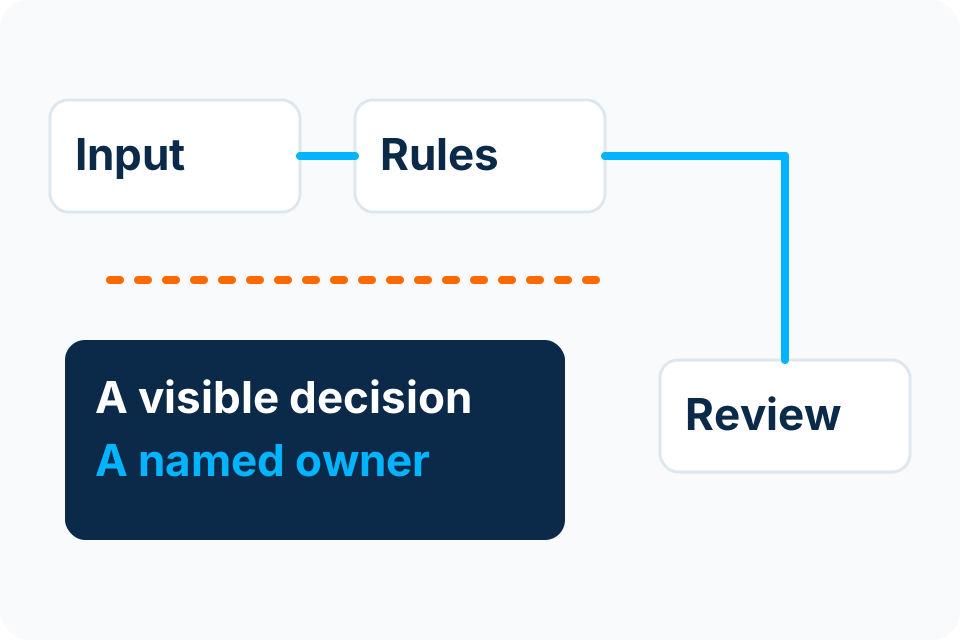
Document automation starts with knowing what arrives and what must be checked. A clean sample PDF is not enough to define the production requirement.
Build a representative input set
List the document types, arrival channels, languages, layouts and scanning conditions that occur in the real process. Include incomplete, rotated, faint, multi-page and revised records where those are relevant. Keep the sample proportionate and use an agreed method for confidential material.
Label the sample’s limits. A small set from one supplier does not establish performance across every supplier. If historical documents differ from current ones, separate those groups so a migration requirement does not become an unspoken part of ongoing intake.
Define fields by business use
| Field question | Why it matters |
|---|---|
| What does the field mean? | A document date and a received date are different facts. |
| Is it mandatory? | Missing critical data may require a hold rather than a guessed value. |
| Where is the source? | A reviewer needs a way to compare the extracted candidate with the document. |
| What can validate it? | An approved reference or arithmetic rule may expose a mismatch. |
| Who resolves conflict? | Contradictory source information needs business ownership. |
Create a short field dictionary with examples and permitted formats. Avoid adding fields simply because an extraction service can return them; every collected value needs a purpose.
Keep confidence and correctness separate
Microsoft describes confidence values as estimates associated with supported outputs. They can help prioritise review, but they do not prove a document is genuine or that a transaction is authorised. Some output types may not provide the same confidence information.
Design a review path for critical fields and contradictory evidence even when a result appears confident. Test a plausible wrong value, not only a visibly unreadable scan. Set thresholds using your representative sample and the consequence of an error rather than choosing a reassuring percentage.
Decide what happens after extraction
The useful output may be a review pack, a draft record or an approved system update. Each has different access and acceptance needs. A spreadsheet export can be sufficient for a pilot if the business question is whether fields and review steps are dependable.
For invoice work, keep supplier validation, purchase matching and financial approval distinct. Extracting a bank account from a document must not automatically replace approved supplier master data. The destination and the authority to update it belong in the written scope.
Use a readiness decision
- Ready to pilot: representative inputs, defined fields, review owner and test destination exist.
- Needs preparation: source quality or field definitions are inconsistent but can be corrected.
- Hold the implementation: data authority, decision ownership or the permitted destination is unresolved.
This is an original planning framework, not a vendor maturity score. Record the evidence behind the decision and the specific work needed to move forward.
Sources and further reading
Put the decision into practice
Describe the documents, the fields your team checks and the intended destination before sending samples.
Explore Document & Invoice Automation Discuss the requirement by email