
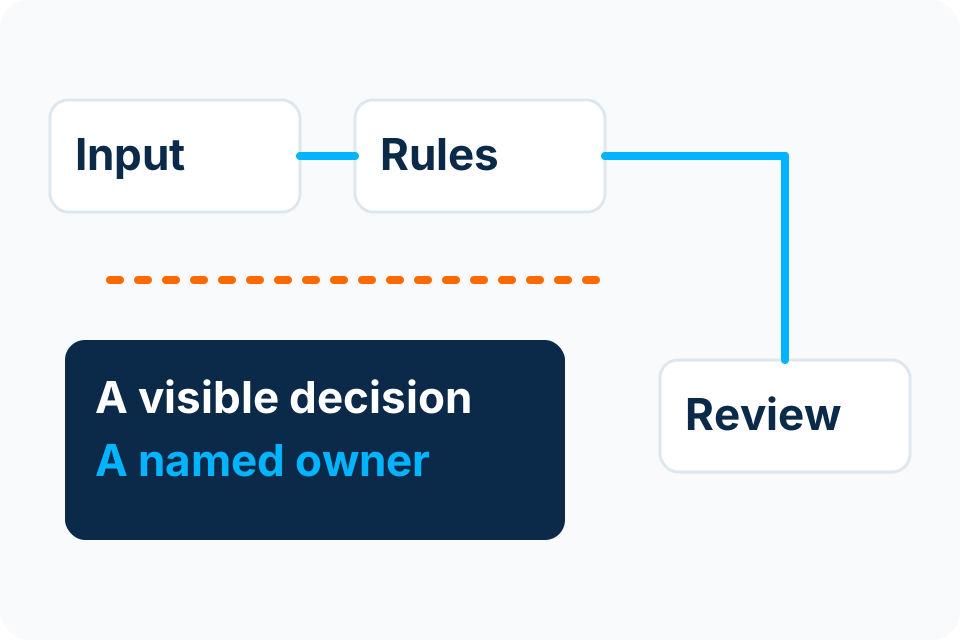
Put human review where the consequence and uncertainty require it. A person clicking “approve” is meaningful only if they have the authority, evidence and time to make the decision.
Separate assistance from authority
An AI system can propose a category, extract candidate fields or draft a reply. Each proposal still needs a defined permitted use. A draft response may be reviewed before sending; a suggested invoice field may need comparison with its source; a consequential record change may require a separate authorised decision.
Start by listing the actions the workflow can take. The review design becomes clearer when “produce a suggestion” and “change the customer record” are treated as different permissions rather than two features of the same assistant.
Choose review points with a consequence matrix
| Situation | Review design |
|---|---|
| Low-consequence draft | A responsible person checks it before external use. |
| Ambiguous classification | Route uncertain or sensitive cases to a reviewer with source context. |
| Material field correction | Show original and proposed values and record the authorised change. |
| Financial or access decision | Keep explicit business approval regardless of a model’s apparent confidence. |
| Unexpected instruction in input | Treat it as untrusted content; do not grant new tool authority. |
This is an original design aid, not a universal risk score. Your organisation should define the actual consequences and permissions for its process.
Make the reviewer effective
Show why the case needs review, the relevant source, important differences and the action being authorised. Avoid a screen that encourages approval through a large green button while hiding the uncertain fields below it.
Allow the reviewer to return a case, correct information within their authority or escalate a disputed decision. Record those outcomes distinctly. If reviewers routinely work around the interface using messages and spreadsheets, the workflow is missing part of the actual process.
Test reviewer failure as well as model failure
Include an absent reviewer, an incorrect but plausible suggestion and a case with contradictory evidence. Check whether a reviewer can still identify the problem without reading a lengthy technical trace. Also test that someone who may submit cannot grant themselves approval authority.
Do not use a confidence score as an approval policy. Its interpretation depends on the component and output; critical business validation remains a separate responsibility. Review thresholds should be supported by representative tests and the cost of a wrong action.
Use feedback without quietly changing the rules
- Record recurring correction types and source problems.
- Have the business owner approve material rule changes.
- Retest affected cases before broader use.
- Keep review workload visible in the business case.
- Revisit access when the workflow gains a new tool or destination.
Human review is an operating commitment. The person, queue and escalation path need to exist after the demonstration ends; otherwise “human in the loop” is only a label.
Sources and further reading
Put the decision into practice
Identify the decisions that must remain with an authorised person before scoping AI assistance.
Explore AI Business Automation Discuss the requirement by email