
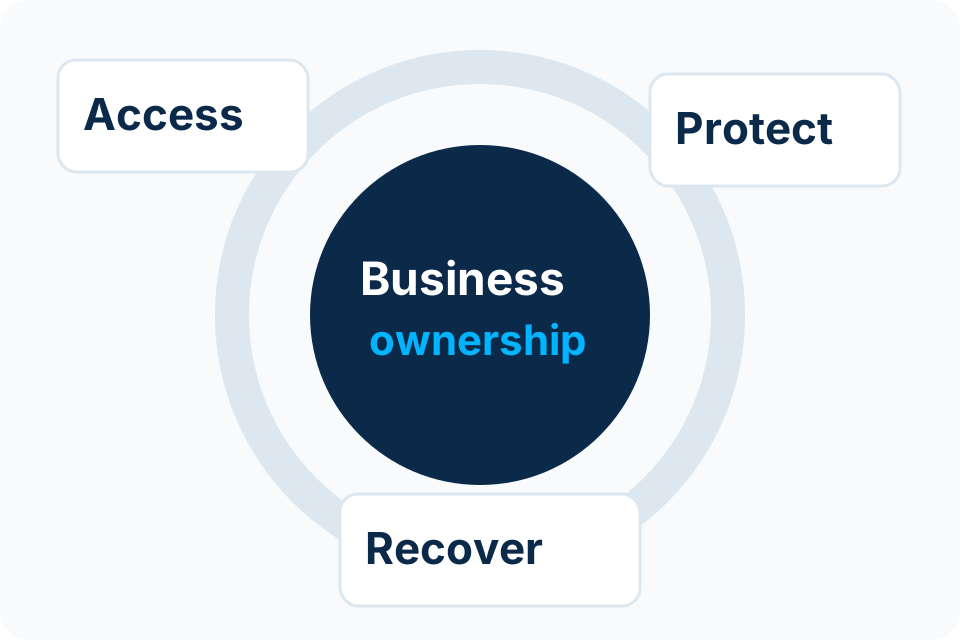
Build a cybersecurity budget from known gaps and the people needed to operate the controls. Buying several tools without ownership can leave the same business risks unresolved.
Name the operations and information that matter
Begin with the work the organisation cannot easily stop and the information it must protect. Identify the accounts, devices, applications, suppliers and recovery dependencies involved. This gives the budget a business basis instead of a catalogue of fashionable features.
A small organisation may need to resolve basic access ownership before adding a complex monitoring platform. A more mature team may need better visibility or specialist assessment. The right sequence depends on the current state, which should be recorded rather than guessed.
Separate cost categories
| Category | What to make explicit |
|---|---|
| Assessment | The environment reviewed and the actionable deliverable. |
| Initial improvement | Configuration, onboarding, migration or remediation work. |
| Licences | Products, users or devices, term and actual entitlement. |
| Operation | Review, maintenance, reporting and escalation responsibilities. |
| People | Internal ownership, staff preparation and approval time. |
| Recovery | Copies, access, tests and dependencies needed for restoration. |
| Specialist work | Any separately confirmed capability and scope. |
Prioritise a gap by its consequence and evidence
For each proposed action, record the gap, affected business operation, available evidence, owner and expected improvement. Keep unknowns visible. A statement such as “administrator recovery has not been tested” supports a clearer decision than an unexplained security score.
NIST’s small-business CSF 2.0 guide provides a broad risk-management structure. Use it to check that governance, protection, detection, response and recovery questions are not lost, while selecting proportionate actions for the actual organisation.
Compare recurring scope carefully
Two monthly proposals may include very different work. One may supply licences and notifications; another may include defined review and authorised actions. Ask about coverage, human hours, reporting, exclusions and customer responsibilities before comparing totals.
Do not treat software running continuously as a promise of continuous human response. Also confirm what happens when users, devices or sites increase and which projects require a separate quotation. Those boundaries materially affect the operating cost.
Use a decision record, not an invented ROI
- The gap and evidence supporting it.
- The proposed action and accountable owner.
- One-off, recurring and customer-retained costs.
- Dependencies and explicit exclusions.
- Acceptance evidence and the next review point.
A security budget cannot guarantee the absence of incidents. Its value is a coherent, owned improvement plan with understandable trade-offs. Avoid assigning an invented probability or loss saving simply to create a persuasive financial percentage.
Sources and further reading
Put the decision into practice
Bring the known gaps and the responsibilities your organisation cannot currently cover.
Explore Managed Cybersecurity Discuss the requirement by email